
Written by Eli Burke
Physiotherapist
Bachelor of Economics, University of Sydney
Master of Physiotherapy, University of Sydney
What is a lateral ankle sprain?
Roll your ankle inwards and the ligaments on the outside of the joint take the strain. A lateral ankle sprain is an injury to those ligaments, usually the one that runs from the outside of the ankle bone forward towards the foot, which is the first to give way and the most commonly injured ligament in the body.
Ligaments are not muscles. They are short, strong bands that hold the bones together and, just as importantly, they are packed with sensors that tell your brain where your foot is in space. That second job explains a lot about why ankle sprains behave the way they do.
What it feels like
- Pain and swelling on the outside of the ankle, often within hours
- Bruising that appears over the next day or two, sometimes tracking down into the foot
- Difficulty putting weight through it, particularly in the first few days
- A feeling that the ankle is not quite trustworthy on uneven ground
Swelling is a poor guide to severity. Some quite minor sprains swell dramatically and some significant ones do not.
The part people underestimate
An ankle sprain is treated as a nuisance injury, and that is why it so often becomes a long term one. Up to around 40 percent of people go on to develop ongoing instability, meaning the ankle keeps giving way or feels unreliable more than a year later (Martin et al., 2021)
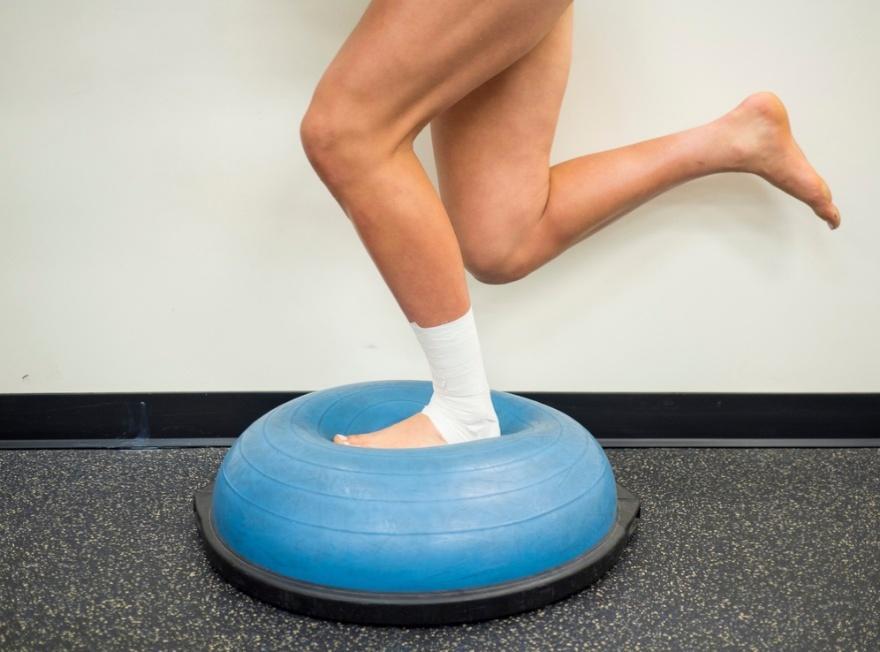
The single biggest risk factor for spraining your ankle is having sprained it before. Most of that risk is not the ligament itself. It is the balance and coordination that were lost when those sensors were damaged and never specifically retrained.
When can I get back to sport?
Sooner than most people think, and the timeline depends on what you do in the first fortnight rather than on how badly it swelled.
What the research actually says
Three findings matter most.
- Movement beats rest. Prolonged immobilisation is not recommended. A short period of protection can help with pain and swelling early, but after that, guidelines favour getting the ankle moving and loaded, using a brace or tape for support alongside an exercise program (Vuurberg et al., 2018).
- Exercise beats passive treatment. Supervised exercise-based programs are preferred over passive treatments, because they restore the joint’s functional stability rather than just settling symptoms (Vuurberg et al., 2018). Ice, rest and a compression bandage will make the ankle feel better. They will not make it reliable again.
- Balance training substantially reduces the chance of doing it again. In a trial of over 500 athletes across a range of sports, an unsupervised home balance program done after usual care cut the rate of repeat sprains over the following year (Hupperets et al., 2009). This is roughly eight weeks of simple work that changes your risk for years.
One caution on anti-inflammatories. They reduce pain and swelling, but they are not without downsides and there is reason to think they may interfere with normal healing (Vuurberg et al., 2018). Useful in the first few days if you need them, not something to take for weeks.
Do’s and don’ts
Do
- Get moving early. Gentle ankle movement and weight bearing as pain allows, within the first few days.
- Use a brace or tape for the first few weeks back in sport. Support plus exercise, not support instead of exercise (Vuurberg et al., 2018).
- Strengthen the calf and the muscles on the outside of the ankle. Heel raises and resisted turning out of the foot.
- Return in stages, straight lines before cutting and pivoting, controlled drills before full training, full training before competition.
Don’t
- Don’t rest it until it feels normal. The ankle usually feels fine well before it is reliable, and that gap is where the next sprain happens.
- Don’t stop rehab when the pain stops. Pain settles in weeks, balance takes months.
- Don’t go straight back into match play. Uneven ground, contested balls and unpredictable direction changes are exactly what caught you out the first time.
- Don’t live in a brace long term. It is a bridge, not a solution.
What else could it be?
Not everything that hurts after rolling an ankle is a simple sprain. Three worth knowing:
- A fracture. If you could not take four steps immediately afterwards, or it is tender directly over the bony points at the back of either ankle bone or over the outer edge of the midfoot, an x-ray is warranted. These are the Ottawa ankle rules, and they are reliable enough to safely rule a fracture out (Bachmann et al., 2003).
- A high ankle sprain. Pain sits above the ankle joint rather than below the bony bump, and hurts when the ankle is turned outwards. These take considerably longer and need a different plan.
- Tendon injury. Pain and weakness behind the outer ankle bone when turning the foot outwards, rather than pain over the ligaments themselves.
When should I see a physio?
Early is better than late with this one, which is the opposite of how most people treat it.
An assessment in the first week should confirm whether imaging is needed, tell you how much protection you need and for how long, and start you on the loading and balance work rather than leaving you to rest and hope.
If you are already past that point and the ankle still feels unreliable months later, it is still worth being assessed. Ongoing instability responds well to targeted balance and strength work, even years down the track (Martin et al., 2021).
If you need your ankle looked at, pop in for an appointment here at Glebe Physio.
References
- Martin RL, Davenport TE, Fraser JJ, et al. Ankle stability and movement coordination impairments: lateral ankle ligament sprains revision 2021. Journal of Orthopaedic & Sports Physical Therapy. 2021;51(4):CPG1-CPG80. doi:10.2519/jospt.2021.0302
- Vuurberg G, Hoorntje A, Wink LM, et al. Diagnosis, treatment and prevention of ankle sprains: update of an evidence-based clinical guideline. British Journal of Sports Medicine. 2018;52(15):956-970. doi:10.1136/bjsports-2017-098106
- Hupperets MDW, Verhagen EALM, van Mechelen W. Effect of unsupervised home based proprioceptive training on recurrences of ankle sprain: randomised controlled trial. BMJ. 2009;339:b2684. doi:10.1136/bmj.b2684
- Bachmann LM, Kolb E, Koller MT, Steurer J, ter Riet G. Accuracy of Ottawa ankle rules to exclude fractures of the ankle and mid-foot: systematic review. BMJ. 2003;326(7386):417. doi:10.1136/bmj.326.7386.417