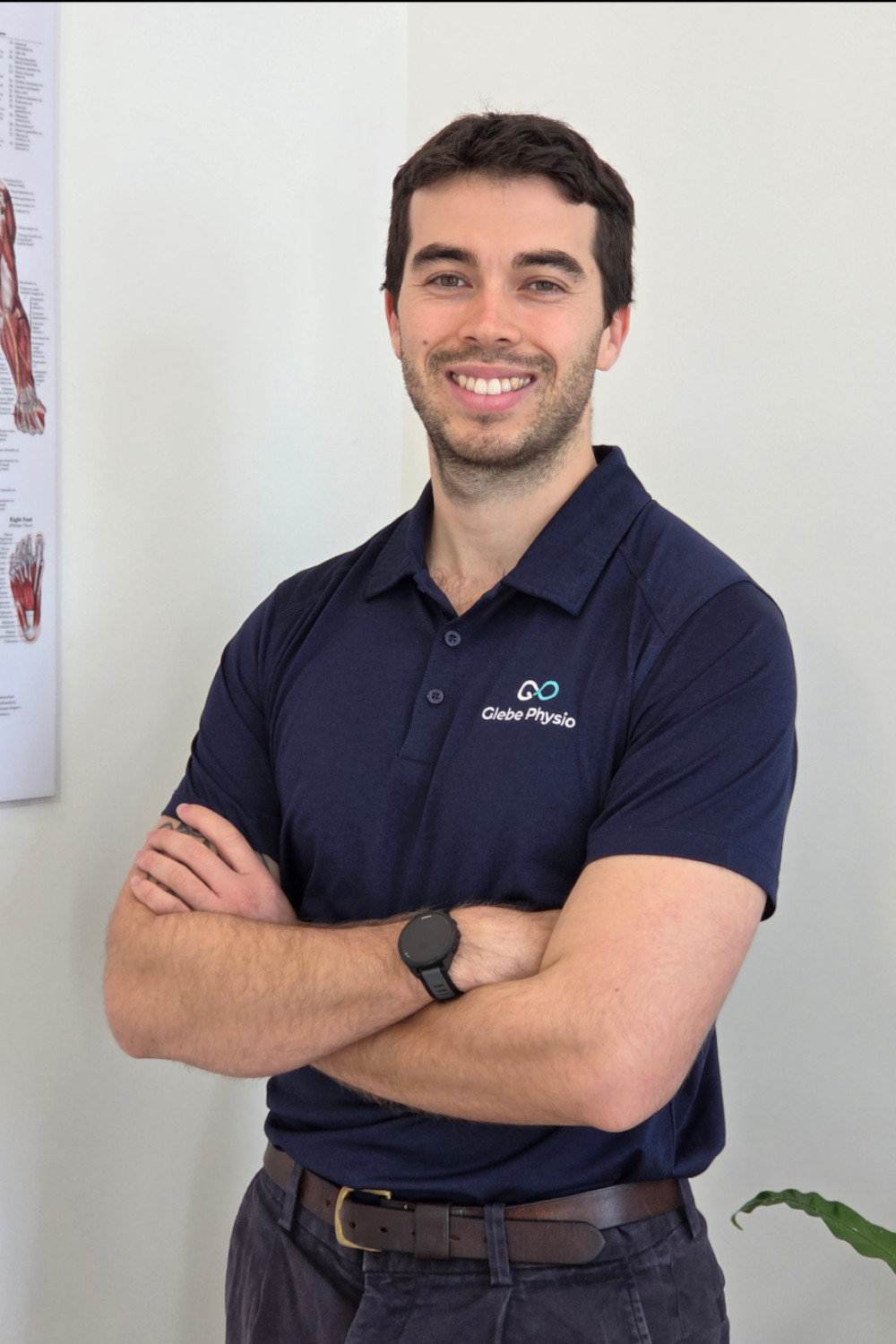
Written by Eli Burke
Physiotherapist
Bachelor of Economics, University of Sydney
Master of Physiotherapy, University of Sydney
What is plantar heel pain?
Along the sole of your foot runs a thick band of tissue called the plantar fascia. It starts at the heel bone, fans out towards the toes, and works like a spring that stores and releases energy every time you take a step. Plantar heel pain, often called plantar fasciitis, is an irritation of that band where it attaches to the heel.
The name is slightly misleading. The “itis” ending suggests inflammation, but what actually happens is closer to overload. The tissue is asked to handle more than it currently has the capacity for, and it becomes sensitive and slightly changed in structure. This is why some clinicians prefer the term plantar fasciopathy.
That distinction matters, because it changes the plan. If the problem were inflammation, rest and anti-inflammatories would fix it. Because it is a capacity problem, the fix is building capacity back up.
What it feels like
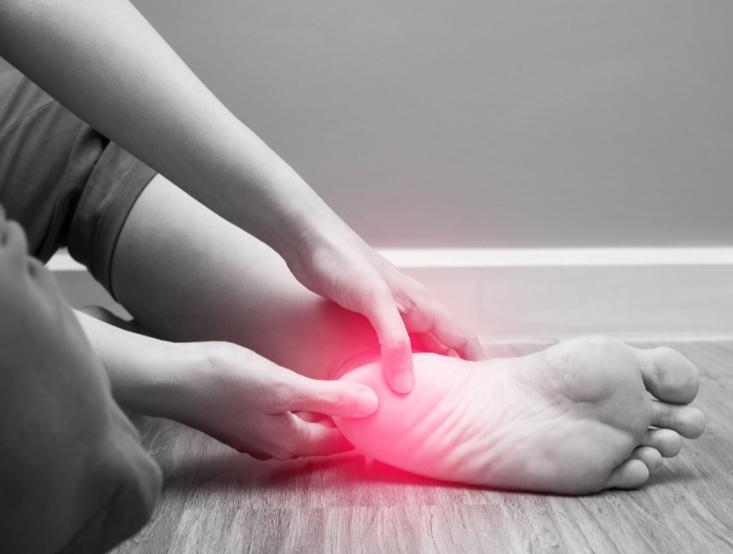
The pattern is distinctive, and most people describe some version of the same story:
- Sharp pain in the heel with the first few steps in the morning
- The same pain after sitting for a while, then getting up
- Pain that eases once you get moving, then returns after long periods on your feet
- Tenderness when you press into the inside of the heel
If that pattern fits, the diagnosis is usually straightforward and scans are not needed.
What makes it more likely
For runners, the common triggers are a jump in weekly distance, running on more days per week, a switch to spikes or racing flats, or simply years of accumulated running.
Outside of running, the biggest contributors are spending long hours standing at work, carrying extra body weight, tight calf muscles, and a change in footwear.
Almost all of these are versions of the same theme. Something asked the tissue to do more than it was ready for.
Should I keep my activity level high?
Usually yes, modified, and only if it passes a daily check. Complete rest is not the answer, because the tissue needs load to rebuild its tolerance. Pushing through whatever hurts is not the answer either.
What the research actually says
The most useful trial on this compared two groups of people with plantar heel pain. Both got shoe inserts. One group did daily stretching of the plantar fascia. The other did progressive heel raises with a rolled towel under the toes, every second day, working up to heavy loads
At three months, the strength group was doing substantially better on a foot function questionnaire. By six and twelve months, both groups had improved and the difference had closed. The practical reading is that strengthening gets you better faster, which matters a great deal if you are trying to keep training.
Stretching is not useless. Plantar fascia specific stretching has its own good evidence, and current clinical guidelines recommend both stretching and hands on treatment. The point is that stretching alone tends to be slower.
On whether to keep running, the strongest evidence comes from the Achilles rather than the heel. In a randomised trial, people who continued running and jumping under a pain monitoring rule did just as well as people who rested completely for six weeks, with no sign that continuing to load the tendon caused harm (Silbernagel et al., 2007). The rule is simple, and it transfers well to the heel.
The daily check
Score your heel pain out of 10 with your first few steps out of bed, at the same time each morning.
You are safe to keep doing your activity if all three of these hold:
- Pain stays at or below about 4 or 5 out of 10 during exercise
- It settles back to your usual level by the next morning
- Your morning score is not trending upwards across the week
If any of them fail, we need to pull back on our activity levels
Do’s and don’ts
Do
- Load the heel every second day. Heel raises with a rolled towel under the toes, done slowly, heavy enough that the last few repetitions are hard. This is the treatment.
- Add weight over time. Start around 12 repetitions and build towards heavier sets of 8. Getting stronger is the mechanism.
- Stretch the calf and the sole of the foot, in short holds, several times a day.
- Use taping or a heel cushion early on to take the edge off while the strength work does its job
Don’t
- Don’t rest and wait. It returns the moment you go back to what you were doing, because nothing has changed about your capacity.
- Don’t take your first steps barefoot on hard floors. Keep a supportive shoe or slipper by the bed.
- Don’t rely on a massage ball. Rolling the sole can ease symptoms, but it does not build capacity.
- Don’t chase an injection early. Corticosteroid helps for about a month, the benefit does not hold, and there is a small risk of the fascia tearing.
What else could it be?
Most heel pain is plantar heel pain, but not all of it. Three patterns are worth knowing:
- A heel bone stress fracture. Builds gradually, worsens the longer you are on your feet, and is often sore when you squeeze the heel from both sides.
- Nerve irritation. Burning or pins and needles in the sole or inner ankle rather than sharp first step pain.
- Fat pad problems. Pain in the middle of the heel rather than the inner edge, without the morning pattern. More common as we get older.
The treatments for these are not the same, which is why an assessment is worth having even when the diagnosis seems obvious.
When should I see a physio?
If the pain has not started settling within a week or two of modifying your activities, get it assessed rather than guessing.
An assessment should tell you three things. Whether it is actually the plantar fascia. How much strength you have lost in that calf and foot compared with the other side, which is usually more than people expect. And how much you can exercise while it recovers
You should leave with a specific program, not general advice.
What if it is not improving?
If a well executed strength program has not moved things after a few months, there are further options. Shockwave therapy has reasonable evidence and is the usual next step. Night splints can help if morning pain is the main complaint. Custom or off the shelf orthotics have good short term evidence for pain and function. Injections and surgery sit at the far end of the pathway and are rarely needed.
None of these replace the loading program. They buy comfort while it works.
What to expect
Most people notice meaningful improvement within one to three months, with continued gains beyond that. Full return to your previous training can take longer, particularly if the pain has been present for a while before you did anything about it.
Progress is measured by your morning score trending down across weeks, not by how the heel feels on any single day.
References
- Koc TA Jr, Bise CG, Neville C, Carreira D, Martin RL, McDonough CM. Heel pain – plantar fasciitis: revision 2023. Journal of Orthopaedic & Sports Physical Therapy. 2023;53(12):CPG1-CPG39. doi:10.2519/jospt.2023.0303
- Rathleff MS, Mølgaard CM, Fredberg U, et al. High-load strength training improves outcome in patients with plantar fasciitis: a randomized controlled trial with 12-month follow-up. Scandinavian Journal of Medicine & Science in Sports. 2015;25(3):e292-e300. doi:10.1111/sms.12313
- DiGiovanni BF, Nawoczenski DA, Malay DP, et al. Plantar fascia-specific stretching exercise improves outcomes in patients with chronic plantar fasciitis: a prospective clinical trial with two-year follow-up. Journal of Bone and Joint Surgery (American). 2006;88(8):1775-1781. doi:10.2106/JBJS.E.01281
- Silbernagel KG, Thomeé R, Eriksson BI, Karlsson J. Continued sports activity, using a pain-monitoring model, during rehabilitation in patients with Achilles tendinopathy: a randomized controlled study. American Journal of Sports Medicine. 2007;35(6):897-906. doi:10.1177/0363546506298279